
You have no items in your cart. Want to get some nice things?
Go shopping
“Naturally; for though many of our English words are each a law unto itself, others offer a key to a whole group, as arrow gives us sp-arrow, m-arrow, h-arrow; but we have alternate days––one for reading, the other for word-building––and that is one way to secure variety, and, so, the joyous interest which is the real secret of success.” (Home Education, p. 214)
Word Study is the best way I’ve found to teach spelling and phonics, alternating days with reading lessons.
How to Introduce a Word Sort
If your child needs help understanding why and how to sort words, explain how animals are sorted into groups, or families; mammals, birds, reptiles, fish, etc. The way they look or sound helps you decide if they’re related. Words are the same: some words look or sound the same and we can predict how to spell unfamiliar words by using familiar words that sound and/or look the same.
Open-Sort
Either write the words in the word family on the chalkboard or give your child the loose words (prepared from step above) and ask them to read through the words and sort them into families. Your child may struggle with identifying patterns on their own, especially if they are a new reader. If they seem confused, skip this step.
Introduce the Patterns
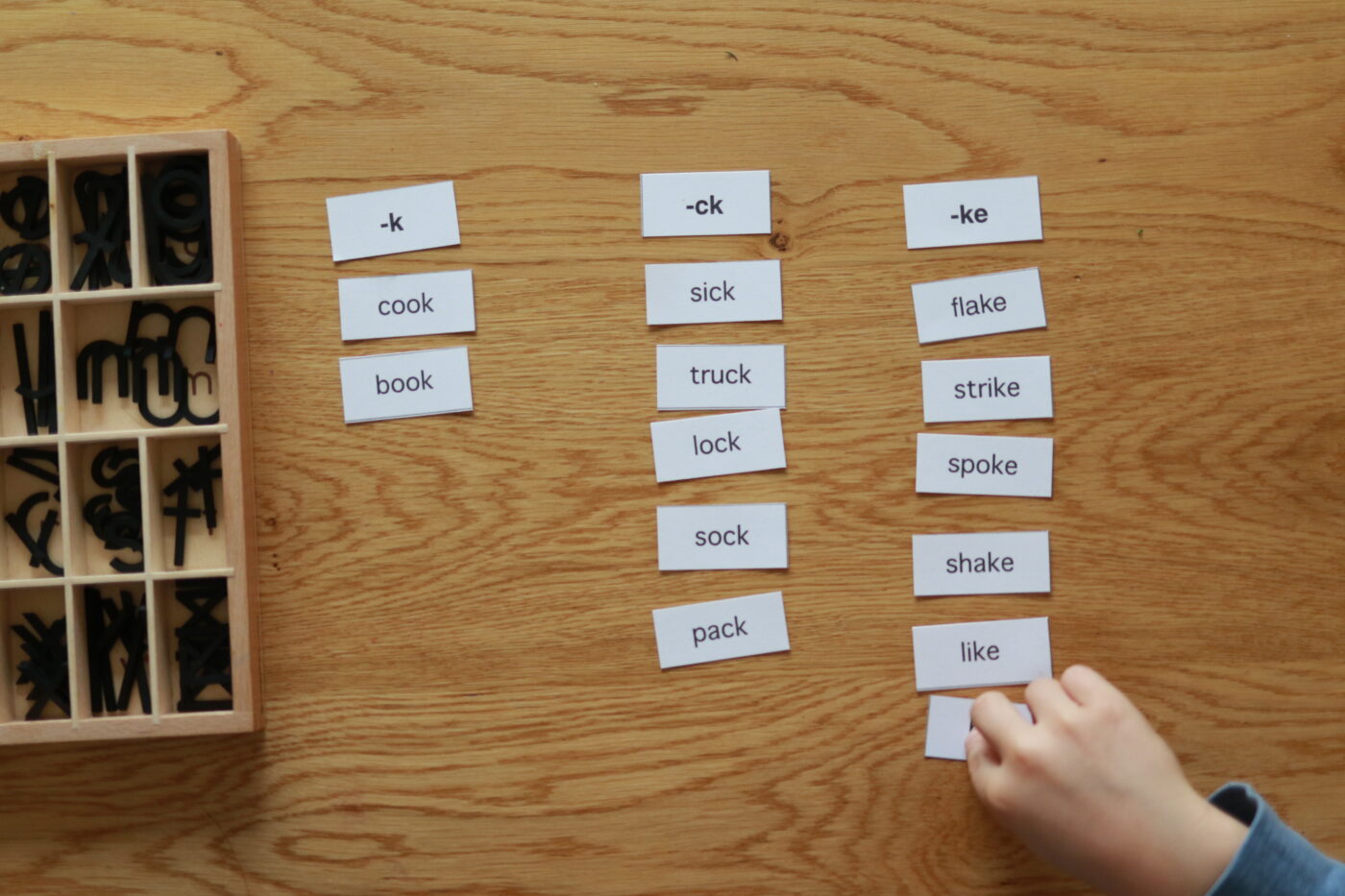
In Home Education, Charlotte Mason describes introducing a pattern in this way: set up the pattern, for example the long o in oat. Then show your child how you can add a g for goat, m for moat, etc. and ask them to build words on this pattern. Write the words you have prepared on the chalkboard as well as any other your child has thought of. (see page 220). Another method is to pick out a word card for each family/pattern (these are called “head words”) and ask your child to sort the rest of the words that sound like, or are spelled, the same way as each head word.
Form Generalizations
“… he sees that the same group of letters need not always have the same sound. But we do not ask him to ‘make a note of’ this new piece of knowledge; we let it grow into him gradually, after many experiences.” (p. 221)
Instead of focusing on rules (which are often broken in the English language), word study focuses on making generalizations. Mason warns against focusing on rules and memorizing them. She recommends simply exposing your child to a variety of words through reading books and word sorts. Then, allowing your child to absorb the patterns without direct instruction. Learning about English spelling requires children to consider sound and pattern simultaneously to discover consistencies in words. This requires both reflection and continued practice. Children discover consistencies and make generalizations for themselves. “Rules are no substitute for experience.” (Words Their Way, pg 87)
The teacher’s role is to provide opportunities that make spelling consistencies explicit and instill habits of looking at words, asking questions, and searching for order. Nurture these habits by asking open/ended questions: “I wonder why these words are spelled this way?” and “what does this word remind you of?”
Write the words on a large chalkboard, if you have one, so your child is immersed in the words and spelling patterns over the week. Your child may figure out a spelling pattern and narrate it to you, but don’t force it on them or give them a lecture on the spelling “rules”—it is rewarding for them to discover truth on their own.
Oddballs
You’ll notice that there are words labeled as “oddballs.” These are words that do not follow the consistencies of the other words in the sort. They should be added in their own category labeled “oddballs.” For oddballs and other spelling words that are difficult, Charlotte Mason recommended having the child look at the word and memorize the letter placement, then close their eyes and visualize the word in their mind. It helps to spell the word with moveable letters; give them all the letters in the word and ask them to put them in the right order. Finally, have them write the word in a sentence, not in isolation.
After they have mastered each list, read the words aloud and ask them to close their eyes and see the word in their mind, then spell the word back to you. Visualization is an important part of the Charlotte Mason method, especially for spelling oddballs.
Daily Spelling Routine
“This process [sight reading] goes on side-by-side with the other— the learning of the powers of the letters; for the more variety you can throw into his reading lessons, the more will the child enjoy them.” (Pg 204)
You may not need to use all these activities for each word sort/spelling pattern. If your child easily discovers the word patterns on his own and completes a blind sort without any mistakes, I recommend moving on to the next spelling pattern. However, if your child struggles to find the pattern and cannot complete the blind sort, I recommend going through each activity until the spelling pattern is completely familiar and understood. If your child still does not understand or recognize a pattern after multiple sorts, it means your child is not developmentally ready for this stage. Simply go back to reading lessons and copywork and observe how your child spells unfamiliar words to know when they are ready for word sorts again.
Open Sort
All the words are placed in the space for the child to see, with the head patterns or words left out. The child looks at the words and tries to notice patterns within the words, creating their own sorting rule(s). Students may even think of a way to sort the words that wasn’t the intended pattern purpose for the sort and that works just fine.
Timed Sort
The child can re-sort the words, but is timed as they do so. Ask them to sort the words as quickly as they can, and see if they can do it faster each day. When they are finished, ask your child to read the words aloud. Time continues until all of the words are sorted and read correctly. This can be repeated and the child can attempt to beat their own time.
Blind Sort
Set up the head/key words only; you can write it on a chalkboard or have it written on a strip of paper. Read the words to the child. Without looking at the word, the child has to think about the pattern in the word and point to the category in which it belongs. Then give the word to the child so they can check their work.
New Words
This is the pièce de résistance of word study. It is the application of knowledge children have gained through word study. First, find unfamiliar words that fit the pattern your child is studying. These are words that were not used in the word sort. In the Words Their Way guides there are additional words to use for this step. For example, if you are studying ay words, ask “what if you wanted to spell the word stray?” How would you figure out how to spell it? What have you learned from this sort that might be helpful?”
Spelling Notebook
“Tommy’s new words are written in his ‘notebook’ in print hand, so he can take stock of his possession in the way of words.” (Home Education, pg 221)
Depending upon the age of your child, they can copy the sort into his daily notebook. They do this at the beginning or during the “written sort” activity. If your child chooses to, they can write the generalization (i.e. family name ) at the top. For example, a sort’s generalization might sound something like: ai comes at the beginning or in the middle of words and -ay comes at the end of words.
A spiral bound notebook works great as a word study notebook, or you can add the words to the child’s copywork notebook. For copywork, use sentences from books, poems, or scriptures that your child found during their word hunt. This also provides opportunities for your child to solidify vocabulary and definitions as they learn how to spell.
Activities for Additional Practice:
Written Sort
This is played like the Blind Sorting Game, but instead of simply pointing to the correct category, the child writes it down under the correct category in his Word Study notebook. This step is useful for children who need extra visualization to cement spellings in their mind.
To prep for this game, the head/key words are written across the top of the notebook page. After the child spells the word that has been read aloud, give the child the word and let them check their spelling. If it is incorrect, they erase the word and spell it again under the correct column. When they sort with the pattern or head words as a guide, this is called a closed-sort. A moveable alphabet can also be used for spell words instead of writing them down.
Word Hunts
Looking for and recognizing words in reading is important because students are learning to discover truth. They must internalize the spelling pattern and look for similarities in words as they read.
Reading from a well-known book, the student hunts for words that are “further examples of the sound, pattern, or meaning they are studying” (Words Their Way, 71). For example, if the child is studying the ay pattern, he may find words such as array or stray in his reading. These words would be written down with the appropriate word family in his notebook.
Games
This is what makes spelling my sons’ favorite subject. We use the words from his notebook to play Hangman. This helps him visualize the exact spelling and letter placement of each word. Play Bananagrams as a whole family, then each person has opportunities to practice their spelling. Boggle is another fun family game where all ages have a chance to spell words on their individual level.
Where Can I Purchase Word Study? (Formerly Words Their Way)
Purchase the Word Sort for whatever stage your child is in. You don’t need to buy the teacher guide, just the word sorts (Emergent, Within Words, Syllables and Affixes, Derivational Spellers). You can use the Spelling Development PDF to help find your child’s stage.
You can purchase from Pearson or Amazon.