
You have no items in your cart. Want to get some nice things?
Go shopping
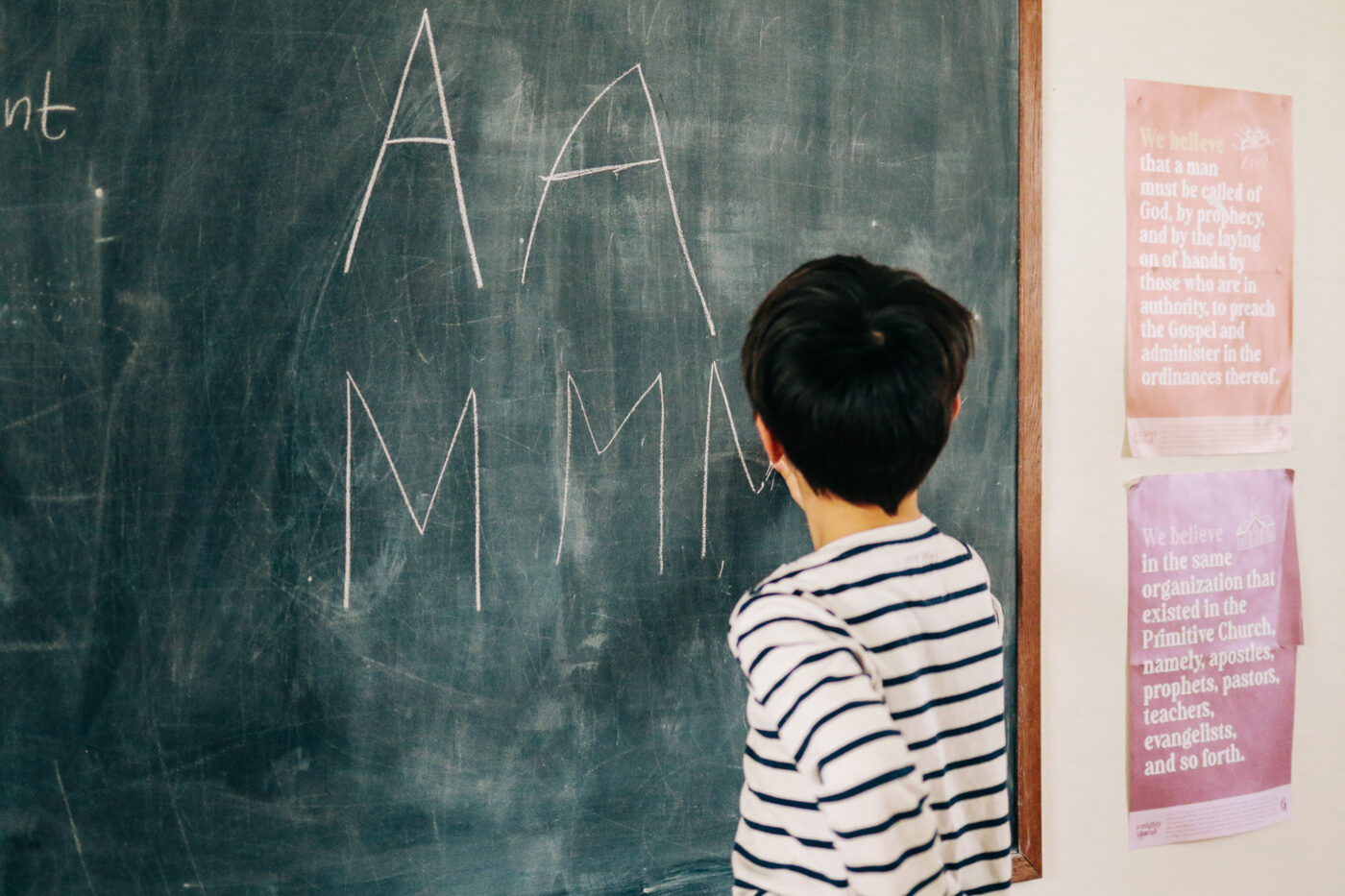
“… if the alphabet be taught to the little student, his appreciation of both form and sound will be cultivated. When should he begin? Whenever his box of letters begins to interest him. The baby of two will often be able to name half a dozen letters; and there is nothing against it so long as the finding and naming of letters is a game to him. But he must not be urged, required to show off, teased to find letters when his heart is set on other play.”
All quotes are from pages 201-202 of Home Education
Your child is in this stage and may be ready to read if she:
- Represents beginning and ending sounds of words.
- Uses letter names to invent spellings.
- Points to a word and ask you to read it.
- Read simple words in beginning reader books.
Make Lessons Child-Led
“As for his letters, the child usually teaches himself. He has his box of ivory letters and picks out p for pudding, b for blackbird, h for horse, big and little, and knows them both. But the learning of the alphabet should be made a means of cultivating the child’s observation: he should be made to see what he looks at.” (Home Education, pg 201)
When teaching during the early years (ages 0-6 years old), all lessons should be child-led. The child should show interest and desire in learning how to read and write. Please do not coerce or bribe your child. Lessons should be driven by a natural desire to learn how to read.
“If a child chooses to read and write before he is six, let him, but do not make him; and when he does begin, there is no occasion to hurry; let him have a couple of years for the task.” (Mason, Three Educational Idylls, 811)
Reading and writing develops just like other skills: some children start early, others start late. Some children master the skill in a week; for others it could take months, even years! You will most probably see pauses and regressions in their learning. However your child develops reading and writing skills, the key is patience and making your relationship the priority. Stop the lesson before the child’s interest wanes, this is a key to maintaining interest in the long-run. In Charlotte Mason’s opinion, the first six years of life should be a “quiet growing time,” and this method of reading instruction respects that idea.
Letter Formation
Write in Air
“Make big B in the air, and let him name it; then let him make round O, and crooked S, and T for Tommy, and you name the letters as the little finger forms them with unsteady strokes in the air.” (Home Education, pg 201)
Before writing on chalkboard or paper, your child should practice forming letters in the air with his finger.
I teach letter sounds in the same order that Montessori introduced them:
Set one: c, m, a, t
Set two: s, r, i, p
Set three: b, f, o, g
Set four: h, j, u, l
Set five: d, w, e, n, k
Set six: q, v, x, y, z
Say the sound of the letter while you write the word in the air. Your child can use a stick or pencil to write in the air, if he prefers. He can also use other parts of the body to draw in the air, like the nose or feet. Drawing in the air helps the brain visualize the direction and shape of the letter first, without being encumbered with underdeveloped fine motor skills, and saying the letter sound strengthens the recognition between the letter and its sound.
Write in Sand and on Chalkboard
“A tray of sand is useful at this stage. The child draws his finger boldly through the sand, and then puts a back to his D; and behold, his first essay in making a straight line and a curve. But the devices for making the learning of the ‘A B C’ interesting are endless.”
Next, use manipulatives to form the shape of the letter, like sticks or pencils. Another activity you can do is to roll out playdough “snakes” and use them to form the letters.
Now that your child has visualized the shape of the letter and formed it using manipulatives, the next step is to draw the letter on a small, handheld chalkboard.
Using the chalkboard as a guide, your child should write the letter so that it covers the whole chalkboard, top to bottom, while saying the sound of the letter. After writing the letter with chalk, erase it using a small sponge (a sponge from the dollar store cut into small squares). Alternatively, you can use a small tray with sand or salt and the child writes the letter in the sand using their finger. Be creative and find ways to practice writing letters all over! Outside with dirt and sand, inside with shaving cream in a pan, finger paint on a paper, etc.
Letter Recognition
“There is no occasion to hurry the child: let him learn one form at a time, and know it so well that he can pick out the d’s, say, big and little, in a page of large print. Let him say d for duck, dog, doll, thus: d-uck, d-og, prolonging the sound of the initial consonant, and at last sounding d alone, not dee, but d’, the mere sound of the consonant separated as far as possible from the following vowel.”
Now that the child knows letters by sight, you can start playing games with letters to help recognition. Children naturally do this while looking at books and words around the house. You can intentionally do this by using the 3-period lesson introduced by Maria Montessori.
“This is _____.” Point to the letter and say the name and sound it makes. Ask your child to repeat. Do this a couple of times.
“Point to _____.” Ask your child to find the letter L, for example, in a group of moveable letters. If they point to the wrong one simply say “that is __, you’re looking for___”
“What letter is this?” The last, and consequently the most difficult, step is to point to a letter and ask the child to tell you its sound. If they don’t know, just tell them the sound, and have them repeat (i.e. start at step one).
Show your child a letter, for example the letter “H,” and ask them to find things from around the house that start with that sound. You can also play this game with books–just ask your child to find something on the page that starts with a letter sound. I especially love using the Fine Art Alphabet book (download at simple.wonders.org) for this, but you can use any favorite picture book.
Another beloved game is alphabet bingo. You can download FREE bingo boards from the Peaceful Press.