
You have no items in your cart. Want to get some nice things?
Go shopping
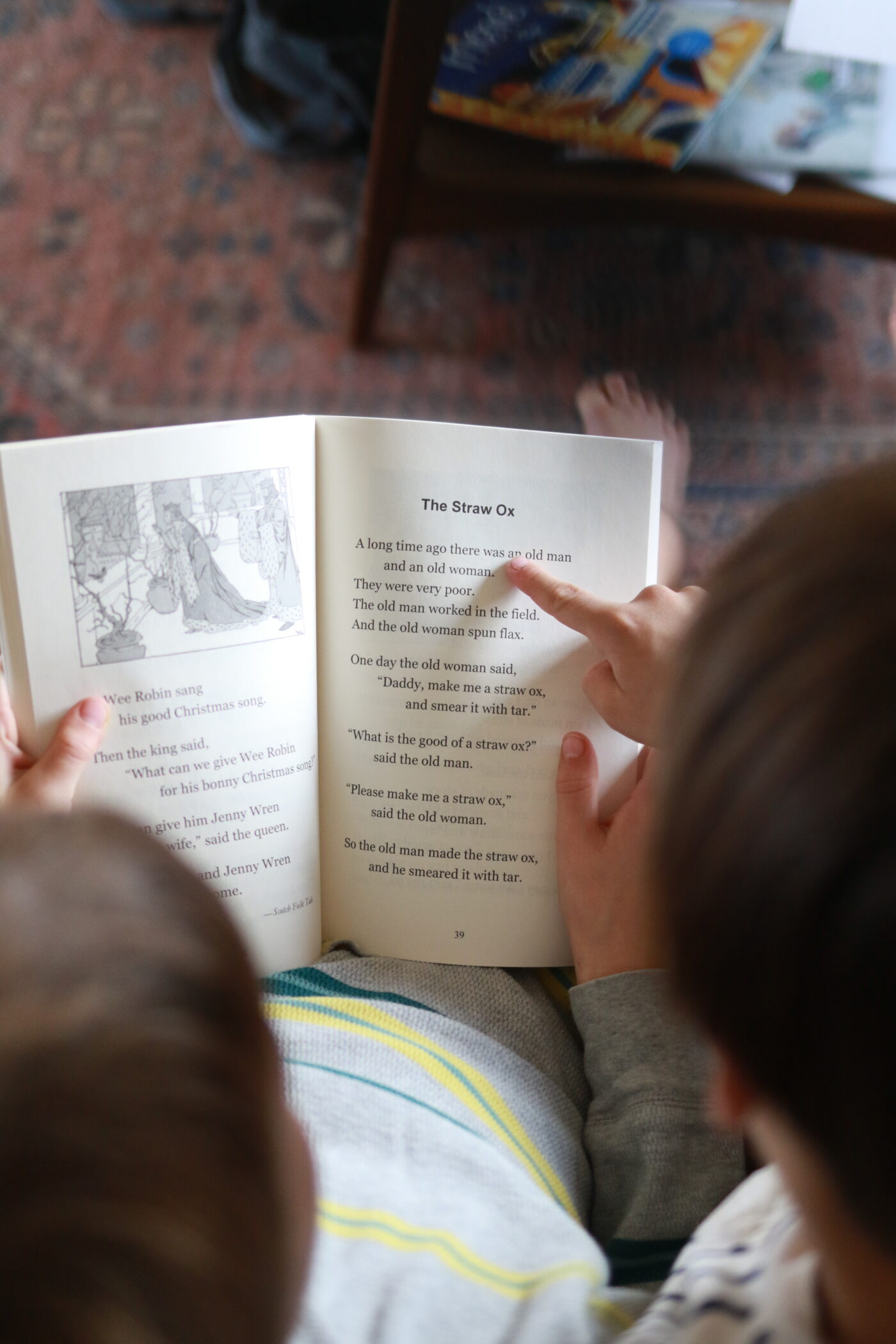
“Lessons in word making help him to take intelligent interest in words; but his progress in the art of reading depends chiefly on the reading at sight lessons.” (pg 204)
If your child has not shown a desire in learning how to read, start at 6 years old and treat the first reading lesson as a special privilege, a “rite of passage.” Begin the first reading lesson on their birthday, or another special day, and set aside the morning just to spend uninterrupted time with them for their first lesson.
Mason recommends having reading lessons every other day (in tandem with spelling) and to learn to read ten words, on average, each lesson. This obviously depends on the child and the day, but is a useful guideline
For your first reading lesson, find a beloved book, poem, or song. Words are simply symbols for things, and reading will be much more inviting to a child if the words stand for something that your child is interested in.
How to Begin
Choose high-quality literature. You can find a list of high-quality beginner books in the Form 1 Curriculum Guide. The most important thing is to use books your child is interested in.
Teach your child how to read interesting words, not just 3-letter words from their word sorts. Longer words are actually easier to recognize because they stand-out, versus looking at a list of short words: cat, mat, pat, etc; those all start to look the same. Mason said this of longer words: “The bigger the word, the more striking the look of it, and, therefore, the easier it is to read, provided always that the idea it conveys is interesting to the child.”
Teach correct pronunciation. Make sure your child is learning how to pronounce the words and syllables correctly. This is also a good chance to listen to your child’s speech and ensure they are able to make their sounds.
Know the words they learn. After teaching your child a word, ask them to find the word on another page and point it out to you. Use Montessori’s three-period lesson (see next page) to check that your child is learning to recognize the words in different contexts.
Keep lessons short. Mason makes it a point that we should stop the lesson before our child’s interest wanes. If we try to drag it out longer it will become a chore instead of a privilege and enjoyment. Most reading lessons are about ten minutes, but adjust them to your child’s ability.
Two Methods of Reading
Charlotte Mason described, in detail, two ways you can teach your child to read by sight. I will describe these methods from my own understanding, and use a line from the poem “Mix a Pancake” by Christina Rosetti.
Make sure you will be undisturbed during this lesson time. Since this is a multi-day event, I recommend having a special box with toys and puzzles that are only taken out during this time for any younger siblings to keep them occupied. It could also be during naptime. Whatever works for you; just make sure you are not distracted. Each lesson should be between five to ten minutes. Gauge your child’s attention and end the lesson before their attention wanes. Once your child is reading fluently, change the reading lessons to individual reading time, with books chosen based on your child’s interest and ability, and eventually reading lessons are eliminated and children read their own school books.
Children with dyslexia will most probably need to spell out each word with moveable letters—a more tactile, intensive approach. While others may only need to sound out a word once or twice to remember it.
If they are struggling to remember words or comprehend what is read, try method two, and so on until you find the method that works best for your child.
“Mix a pancake, stir a pancake, pop it in the pan.”
Method One
In preparation for your lesson, type up and cut out all the words from the two sentences you will be using, and print six copies of the sentence. You can use the same template that you use for creating word sorts. Download template here. I store the words in the same plastic ArtBin I use for word sorts. You should also have a blackboard or dry erase board on hand as well.
- Choose the most interesting word from the sentence and write it on the blackboard. Let’s use pancake.
- Say the word you have written, and ask your child to repeat.
- Give your child a group of the word cards and ask them to find all the pancake cards. Do not give them all the cards at once, as this will be overwhelming. Mix the six pancake cards along with 10 or more of other word cards.
- Repeat steps 2-3 with all the words in the sentence, leaving them written on the blackboard as a list (writing on blackboard is optional; just adds extra element in seeing words spelled and sounded out)
- Ask your child to read all the words he has learned from the sentences in random order, backwards and forwards.
- Play a game where the child must arrange the word cards into the same order as they are on the blackboard.
- Allow your child to create his own arrangement of words and read them.
- Dictate a sentence slowly, and let the child find the right word cards and arrange them into the sentence. Continue doing this with twelve or more different sentence arrangements.
Method Two (more tactile approach)
If the previous method was unsuccessful, it may be that your child needs a more tactile, hands-on approach to learn how to read words. This method employs the moveable alphabet to imprint the words in the child’s mind. As with method two, print and cut out the words from the example sentence to use for this lesson.
- Choose the most interesting word from the sentence. Pancake is usually the most interesting to a child.
- Write the word on the blackboard, and as you write each letter say the sound: p-a-n-c-a-k-e
- Say the word you have written, and ask your child to repeat.
- Have your child look at the word until they are sure that they know it. Ask them to close their eyes and imagine the word in their mind.
- Next, give them the moveable alphabet and ask them to form the word with letters. You may need to pick out the letters for the word, mix them up, and let the child arrange them in the correct order.
- Have your child find the word he just learned from a pile of the word cards.
- Then, find the word in the sentence on the page (in the beginner reader book each phrase is in it’s own box)
- Repeat steps 2-6 with each word in the sentence. Leave all the words on the blackboard, in a column.
- Once your child finds a new word card in the pile, have them add the word card to the column of previous word cards, in the same order as they are written on the blackboard.
- Ask your child to read, in many different combinations, the words on the blackboard; random, top-to-bottom, bottom-to-top, etc.
- Allow the child to make a column of word cards in any arrangement they choose.
- Dictate a sentence slowly, let the child find the right word cards, and place in the right order. Continue doing this with twelve or more different arrangements.
If you can keep the original sentence a secret, it will bring much joy to the child when they finally read the real sentence in the end, especially if it’s a beloved poem or nursery rhyme.
When you are at the end of the final lesson for all of the words in the verse, allow the child to make up the entire verse with his own word cards as you dictate it to him, and finally read it directly from the book.
This method is not meant to be used long-term. It’s used in the beginning to teach your child the concept of words and reading. But once your child understands this concept, daily reading lessons consist of reading school books together until they are reading fluently on their own.
What Comes Next
Alternate reading and spelling lessons everyday and continue to read aloud school books while your child follows along. This combination of looking at words while you read them aloud and doing word sorts will nurture a love of reading and the skills needed to read any book she wants.
As soon as she is proficient enough, your child should begin reading their school books for lessons. Instead of interrupting to correct every mistake, take turns reading paragraphs so your child has an opportunity to hear the words read correctly. Give her the opportunity to fix her own mistakes or ask you for help before jumping in to correct.
Continue word study until your child finishes the Words Their Way series. This, along with copywork, will give her a solid foundation in phonics and spelling.