
You have no items in your cart. Want to get some nice things?
Go shopping
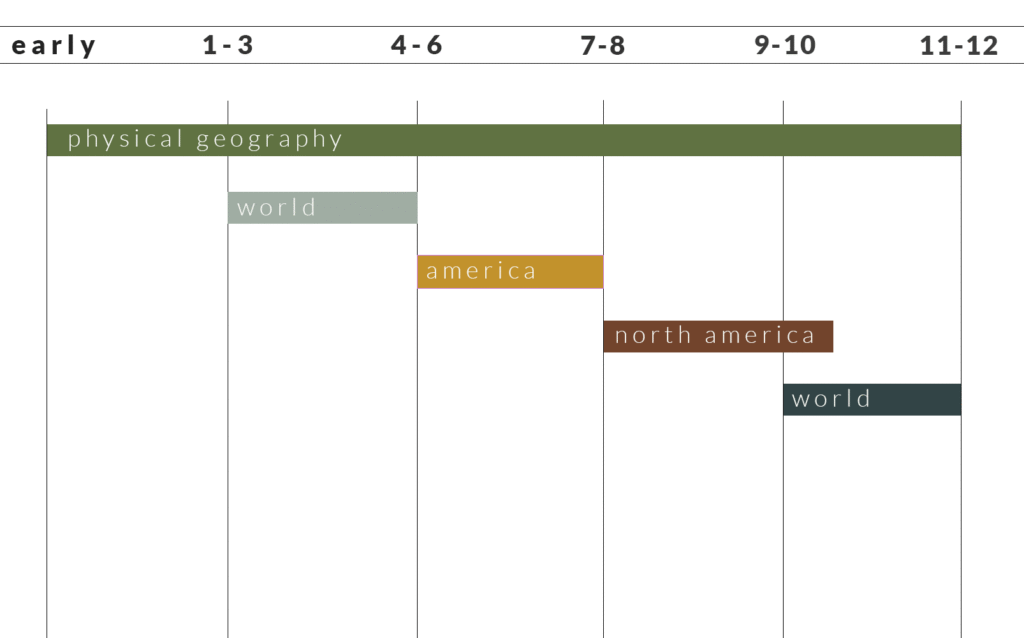
*This is the scope and sequence suggested by Charlotte Mason and how it was taught in her schools. After teaching geography in a family setting I’ve adapted her methods and changed how I teach to fit our needs. You can read how I teach geography HERE. You can teach it by form and I hope this page will give you the tools you need to do that.
Physical geography is simply learning about geography in concrete ways. This is usually done through “geotrots” in your area. My family and I try to take a few hikes each year around our state where we can experience the geographical regions. It’s helpful to look up the geographical regions of your state and look up state or national parks in those regions to visit. You can call ahead and ask about any ranger talks or just go to the visitors center and learn what you can from there. My family’s favorite way to study physical geography is to visit National Parks — we read about it beforehand and attend ranger programs while there.
In this form children learn about the world through world culture and every day lives of children around the world. I like to use picture books of folktales, myths, and legends. I also use the book Children Just Like Me and Dangerous Ways to School documentary on YouTube. During this form children also read through Elementary Geography by Charlotte Mason to gain a foundation in geography knowledge before moving on to map drills and map work.

In form 2 (grades 4-6) students focus on US geography, or their own country if you don’t live in the United States. There are a few different books you can use for this, my boys have enjoyed Little Stories of a Big Country by Laura Large, Cross Country by Paul R Hanna, and Book of Indians by Holling C. Holling. Honestly, I love the book by Holling C Holling book and I feel it does an excellent job of teaching kids about the geographical regions of the US through the lens of the different tribes that lived in each one. These books are great for references, but not as a “spine” for your geography study: National Parks of the USA by Kate Siber, 50 States: Explore the USA by Gabrielle Balkan,
At this age children begin map drills and map making.
After studying their home country, children move outward to the continent they live on. For many of you this will be North America. Many Charlotte Mason curriculums recommend North America by Nellie Burnham Allen. You can purchase a physical copy or read it for free on archive.org. I haven’t personally read the whole book, and from what I’ve read it’s living, though perhaps antiquated in it’s language and opinions. Many families use Holling C. Hollings books as an American, or North American geography study. These include: Minn of the Mississippi, Tree in the Trail, Seabird, and Paddle-to-the-Sea. There is a wonderful series on PBS called “North America.” It would be a good substitute, or at least a good supplement to a book.
At this age children begin reading/watching the news and looking up places they hear about on a map or atlas.
For this age I recommend reading Prisoners of Geography by Tim Marshall and Physical Geography by Geike. Students continue doing map drills and map work, but will consist revolve around current events on the news.
Another book my children love is Richard Halliburton’s Book of Marvels (Occident and Orient). This is appropriate for all ages (and all but the youngest of my children enjoy listening), but may be most appreciated by high school students. My family loves Planet Earth and Human Planet. Human Planet may be more appropriate for high school students and will supplement their readings well.