
You have no items in your cart. Want to get some nice things?
Go shopping
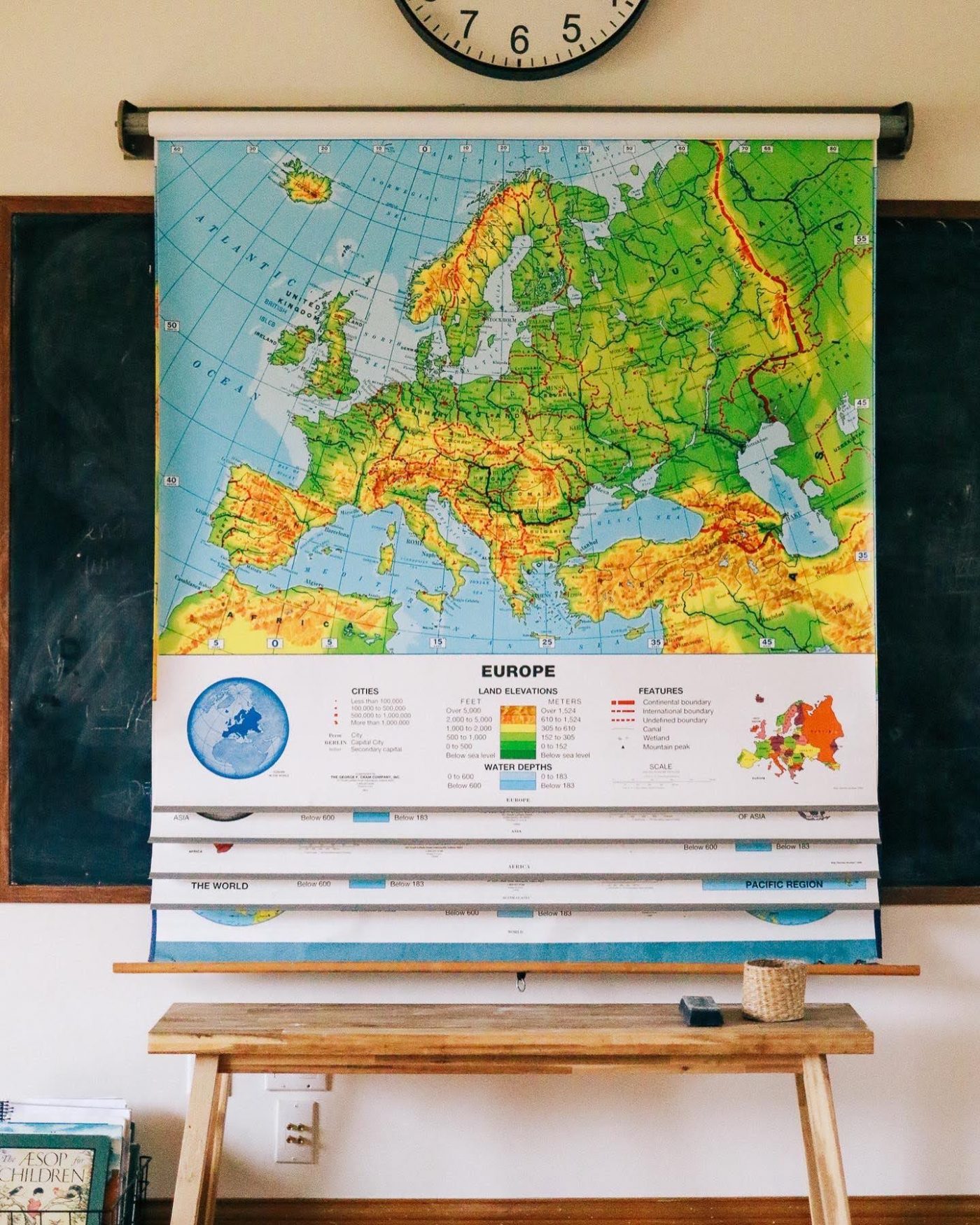
Map Drills and Map Work
Once children finish Elementary Geography and have made maps of places they know (like their neighborhood, a park, or their town) then they are ready to answer map questions. I usually begin in 2nd or 3rd grade.
In form 2 geography lessons consist of map questions (aka map drills), map work, and world culture.
Thinking up map questions can be a real drain of mental energy, so I occasionally use ChatGPT to generate questions for me, or at least generate the bulk of them, and then I add in a few specific to the atlas we use (DK Compact Atlas 7th edition).
Here are some ideas for map questions:
- Bordering countries
- Large bodies of water and what direction (north, east, south, west)
- Land and water formations, such as: islands, lakes, peninsulas, bays, gulfs, straits, isthmus, capes, fjords)
- Mountain ranges
- Highest peaks
- Elevation (i.e. how many feet above sea level)
- Largest cities
Here is a general prompt to use for ChatGPT
“generate map questions for [country]. Include questions about land and water formations, such as islands, peninsulas, bays, straits, and mountains. Also include questions about bordering countries and large cities. Include answers.”
Make sure you look at the map you’ll be using for lessons to ensure the questions are accurate and answers can be found on the map.
Once children answer map questions, both while looking at the map, and from memory, I have them fill out a blank map with everything they remember from previous lessons. Then they look at the map afterwards to see what they got right, or missed.
Instead of, or in addition to, filling out a blank map you can have your child make a relief-map with salt dough or clay. My boys LOVE doing this because they can make mountain ranges, lakes, and other formations in 3D.
You can find directions for a salt dough map from Rachael Alsbury’s blog.
Travelogs + World Culture
Since I’m teaching multiple ages in a family setting I’ve made adjustments to Charlotte’s method. For example, instead of each form studying a different country or continent (see Scope and Sequence below) the whole family studies the same continent for the year. We watch documentaries in addition to reading a book (if I can find a good one on a continent or countries). I haven’t been able to find a good amount of current living geography books, so I add documentaries to fill those gaps. We enjoy Richard Halliburton’s Book of Marvels. For high schoolers and adults, Bill Bryson writes excellent and humorous travelogs. Prisoners of Geography is an excellent book on how physical geography has affected a country’s (and world!) politics. We focus on one continent each year (I combine Australia, Antarctica, and the Arctic).
I’m not sure if documentaries would be considered “Charlotte Mason approved” but when you look at the principles, “to nourish the mind with ideas and furnish the imagination with pictures” I feel that documentaries do just that. In fact, I think they do it better than books because a child is actually seeing what that place looks like instead of imagining something completely different. I wholeheartedly believe in children using their imagination to see imaginary worlds in fiction, but when it comes to geography I think it’s important to see exactly what other countries look like.
Map work and drills and watching a documentary are the “floor” of our geography lessons. If I only have time for a few minutes of geography in the morning then we do map drills and watch a documentary during the afternoon or on the weekend as a family. I try to get a read-aloud book, either fiction or a travelog, that fills my child’s heart and mind with rich ideas related to the geography of that country. Some bonus material that we add is world culture, in the form of picture books, folksongs, architecture, and cuisine. We may read a picture book during lesson time, but everything else is an afternoon or weekend activity.
Printable Maps
https://online.seterra.com/en/pdf/4167
https://d-maps.com/pays.php?num_pay=272&lang=en
https://www.geoguessr.com/l/pdf
World Culture
https://folkways.si.edu/lesson-plans (wonderful folksong lesson plans!)
My Family Gather document has a lot of picture and chapter books to read
Our Favorite Documentaries
Dangerous Ways to School on YouTube
Human Planet by BBC (WARNING: cultural nudity in some episodes)
Frozen Planet by BBC
Europe From Above by National Geographic
India From Above by National Geographic
Ancient China From Above by National Geographic
Earth’s Great Rivers by BBC
North America by Discovery Channel