
You have no items in your cart. Want to get some nice things?
Go shopping

This week youll take everything you’ve learned in the past eight weeks and put them together to plan our your school year! 🥳💃 Before we begin, lets go over some principles… While there isn’t one right way to plan, I’ve found some timeless principles can apply to everyone.
You don’t necessarily need a planner, although I made my own to help with my own planning, you can use any planner that works for you, even a lined notebook from the dollar store can work with this method.
Divide and Conquer
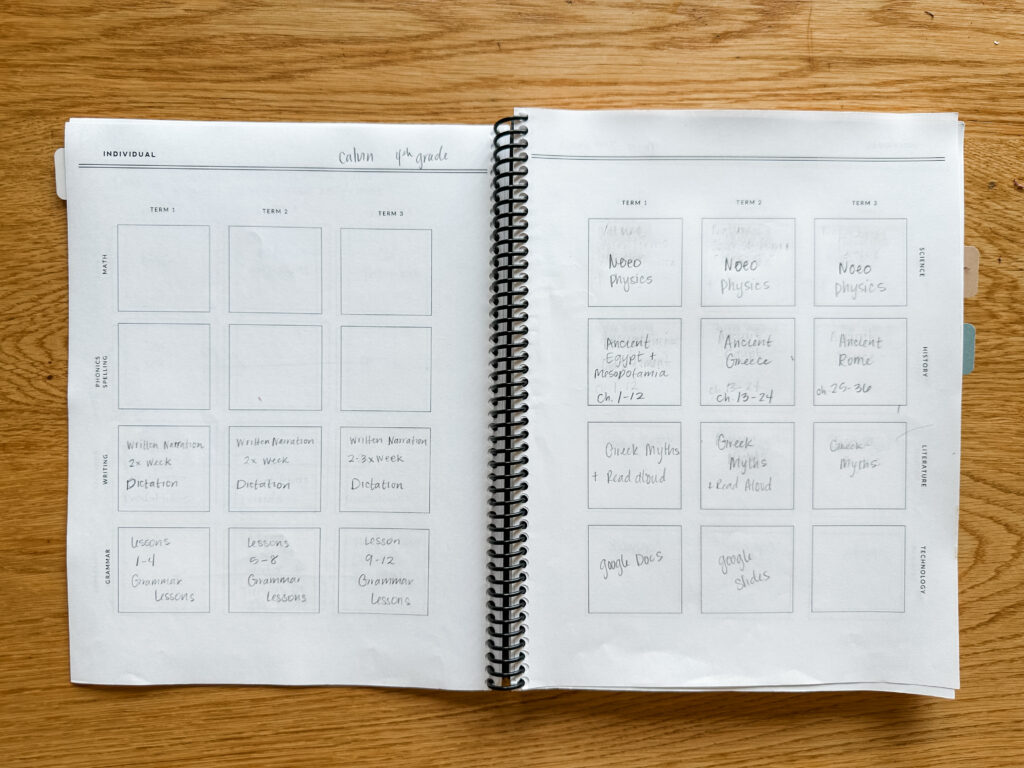
I divide up my school year into three 12-week terms. During that time we do 5 weeks of school (the whole “feast”), and during “rest week” we either do light school and house projects, or take a break from school completely and go on field trips and adventures.
One term = 5 weeks of school, 1 rest week, 5 weeks of school, rest and/or exam week. I like to add these rest week to my Google calendar along with the part of the house we’ll be cleaning/organizing.
I’ll link the exams, prep week, and housecleaning videos at the end of this post.
It’s so much easier to plan for 12-week blocks than an entire 36-week school year. Breaking it down into terms will save you time and mental energy.
We used to do school year-round, but it was too exhausting for me. I needed that summer break to rejuvenate and relax. We do have more breaks during the school year because of rest weeks, so our year extends into June, but I appreciate having July and August off of school to let our minds relax. We still do a lot of real life learning during the summer, just not formal lessons.
Think of your mind like your body – it needs breaks from exercise and food. It is healthy for our bodies to sleep and fast during the night. I like to think of summer break like nighttime; it is a time for our minds to sleep and fast. We still learn and grow during the summer, just in different ways.
Structure Time, Not Content
I don’t recommend starting the year by looking at how many lessons there are in the curriculum, or how many pages there are in a book and then dividing that by the amount of school days in the year. This is an unrealistic goal and developmentally inappropriate. In my experience, you are setting yourself up for failure and constant anxiety. If you have assigned a certain amount of lessons per day or week, and you miss a day, then you have to rewrite your schedule to accommodate. If your child isn’t developmentally ready to master a subject, then you also have to rewrite your schedule to accommodate their individual growth and learning pace as they take longer than you anticipated to master a skill.
Instead, decide how long your child will study each subject each day and then simply work on lessons or read books for that amount of time. Sometimes the timer will go off and my child is in the middle of a problem and they finish that problem, but we don’t feel pressure to finish a whole lesson, chapter, etc.
Don’t be a slave to the curriculum, make it work for YOU!
Forecasting
When I was young, back when we didn’t have weather apps, everyone watched the 6 and 10 o’clock news. I’m sure most of you remember that ancient form of communication. The meteorologist predicted the weather based on a variety of different factors. The predictions were rarely exact, but they were accurate. It is extremely difficult to predict the exact moment it will rain and the exact amount. But we knew there would be rain and there almost always was.
I like to think of planning my homeschool year as forecasting, or predicting. I know we’ll study Ancient History – Egypt, Greece, China, South America, and Rome– but I don’t know exactly when we’ll finish each book and I don’t know exactly when we’ll begin each topic from that time. I know we’ll study Africa for geography, but I’m not sure how long we’ll want to study each region and country.
At the beginning of the year I forecast what we’ll study (which is according to my Family Gather Rotation) and I choose which books or which curriculum we’ll use. That is the most time consuming part. After that, we’re flexible. I may have a slow reader, or a quick reader. We may take longer learning about Ancient Rome because there are more books and more interest, or we may spend more time on Ancient Egypt. The important thing is that I have a direction, a plan, and we are consistently doing school every day.
BUT, if I don’t have a lesson planned out each day, how do I know what to do? How do I stay organized?

Reverse Planning
Instead of dictating what I want my future self to accomplish on a weekly or daily basis, my present self writes down what we did accomplish that day. This is also known as “reverse planning.”
My daily logbooks are designed around this concept. I have the subjects (and sometimes books) they are required to do each day along with the amount of time. There is a circle next to it for them to mark off when they’ve finished that subject. I’ve also left extra space underneath to write down what they did during that time.
There are actually a couple ways you can go about this. The first is to just record what you did that day (as I mentioned earlier). My younger boys don’t usually record what they did, so I record it for them. My oldest son, who is twelve, records his work on his own.
Another method is to write down assignments the night before. Each evening look back on what they accomplished the last day and write down what they need to do or read next. For example, on Tuesdays and Thursdays literature is assigned. So if it’s Monday evening look at what you read on Thursday (let’s say chapter 6), and you’d write chapter 7 underneath “Literature.” If chapter 6 was assigned last Thursday but they didn’t read it, then you would simply assign it again on Tuesday.
What If I Don’t Finish?
If I could choose one thing that gives moms the most anxiety it would probably be this – what if I don’t finish the book, curriculum, or class by the end of the year?!
I’ll let you in on a secret: Just because you didn’t finish doesn’t mean all the knowledge they acquired is null and void. They still learned a lot during the year!
In Charlotte Mason’s schools they sometimes didn’t finish the book by the end of the term or year. Instead of trying to finish the book, and therefore cramming too much in during the year, the students were invited to finish the book during the summer. You can also put a book mark in your curriculum, book, etc. and pick it up again the next year.
Avoid Overplanning
The anxious need to finish something during a prescribed time period usually ends up in cramming too much information into one year, which actually ends up in less learning. Yes, you read that right. In the book Powerful Teaching, the authors (who are teachers and cognitive scientists) point out that retrieving knowledge is when we truly learn, and prioritizing encoding (putting info into the mind) over retrieval (taking info out of the mind) ends up in less learning and wasted time.
Although it may be hard, try to remove that anxious need to finish a curriculum or book during a prescribed (and might I say arbitrary) time period and simply learn every day – reading just enough to learn, and spend a good portion of that time narrating (retrieving) what you learned. You will get through less, but your child will learn more.
Ok, those are my principles for planning that can be used for most curriculums and educational methods. Now, I’m going to share how I create a custom learning plan for content-based subjects (the ones we study family style).
Homework Assignment
Divide your year into smaller, bite-sized pieces. Forecast what you’ll learn during that time and write it down, for both the family and for individual children. Schedule in your rest and exam weeks and put them on your calendar.
Extra Credit
Watch these videos to learn more about exams, rest/prep week, and housecleaning.