
You have no items in your cart. Want to get some nice things?
Go shopping

The average homeschool day is not usually orderly, tidy, or picture-perfect. But it can be memorable and life-giving. Here’s what to expect from a typical homeschool day — from how long it will take, how family relationships with change, how to teach multiple ages, and if you can balance all your responsibilities.
How Long Should I Expect to Spend Doing Schoolwork?
1 ½-2 hours in elementary school
3-4 hours in middle school
5+ hours in high school
You are not doing school for 7 hours a day. You can get so much done in just a couple hours. When I was homeschooled I only spent 4-5 hours total on my schoolwork in high school (this included the reading assignments, lessons, and homework) and I did extra so I could graduate a year early. A lot of time in public school isn’t actually spent in lessons. Much of it is spent waiting in line, waiting for the class to settle down, doing busywork because there is a substitute. You only need to spend a fraction of time doing lessons at home because one-on-one instruction is more efficient and effective.
I dedicate our mornings to formal lessons, but a lot of our learning gets spread throughout the day. We have a book we read aloud at lunch, we discuss what we learned that day at dinner and my boys “narrate” to their dad and each other about what they learned. We do handicrafts and science experiments in the afternoon when my toddler is napping. When you homeschool, learning becomes a way of life. Not a separate part of your life that has to happen in a separate building with a professional teacher and only with kids within 1 year of your age.
Mixed-age Classrooms
When children play with children of all ages they learn better social skills than just with kids their own age. There is something magical that happens when a child takes care of, or teaches, a younger child. Or when a younger child looks up to an older child and adapts their behavior to be more mature and fit in with the older kids. Studies on mixed-aged classrooms show that there are so many benefits, the question is why we don’t do this more often in traditional schools. The most important conclusion from one of the journals on education is that “Mixed-age groups are more reflective of the social groups that children will encounter throughout their lives.” (source)
However, having siblings and multiple ages together more often will result in more interactions, both positive and negative. Is sibling rivalry a bad thing?
Sibling Rivalry
When siblings are together more you’ll notice more sibling rivalry; but is the actual amount of sibling rivalry increasing because of homeschool, or is it just because they spend more time together? In my own family I’ve noticed a lot of sibling rivalry and negative interactions, but also a lot of positive ones. One night each of my boys came into my room, separately, to tell me that they wished they were only children and asked if there was some way to send their brothers away to relatives. Then a few days later at a town celebration my two oldest boys left together to buy snowcones. My third son tagged along, but he had no money to spend and I prepared for a torrent of whining and crying and gnashing of teeth. What I saw instead brought happy tears to me eyes: all three boys’ faces were shining with joy and each one had a snowcone. The older boys pooled their extra money together to buy one for their younger brother.
A few years ago a study at Cambridge completely changed my view on sibling rivalry. Researchers wanted to see how negative interactions with siblings affected mental health and social skills in preschoolers. What they found were surprising: Instead of seeing it as an evil that needed to be eradicated, or avoided at all costs, the more “mild” sibling rivalry, the better social skills as adults.
My opinion (I have no research to back this up), is that siblings relationships are deeper and more intimate than peer relationships. They require more forgiveness, more compromising, and more empathy. Therefore the interactions (both good and bad) from familial relationships are much more impactful than peer relationships.

Family-style Learning: The Secret to Teaching Multiple Ages
Although traditional schools are set up in classrooms based on grades, learning can be done as a family. In history, we focus on one historical time period and everyone is reading a book at their own comprehension. Then we come together once a week to share and discuss what we’ve learned and record dates on a timeline. We’re learning about the same nature topic, but, again, we’re reading books at our own levels and coming together to narrate, discuss and learn from each other. For these “content-based” subjects we have daily discussions and time to share.
Sometimes my older boys help the younger ones by listening to them read, asking them math questions or doing “baby school” with the toddler while I do one-on-one work with the other boys.
Learning from and discussing topics with various ages is so much more enriching than learning only from children of the same age.
Learning in a real life context is much more effective than learning in an artificial environment. It will be more sporadic than linear. It won’t be neatly packaged and easily marked off in checklist form.
Learning at home will look different from a traditional school environment and that’s ok.
You may have a dedicated school area, and you may not. All you really need is a table and a place to store your books and notebooks. A place by the kitchen table, or couch is ideal. When we lived in a 1000 square foot apartment I had an IKEA kallax by our small table and I stored the books we were currently reading, our notebooks, pencils, and a few math things. I hung up paintings from our artist study above the kallax, and that was our school area. A chalkboard/whiteboard and globe are a bonus, but not essential.
Housework
In my last video I talked a little bit about the challenge of juggling housework and schoolwork, , as well as homeschooling contributing to a much messier home. As a mom you have 4 main roles (and more if you work part time!): housework, cooking, teaching, and mothering. It is so important to set some realistic expectations before you begin your school year.
You will not be able to complete all four roles every single day. It just isn’t always possible. I set my priorities in this order:
1. Mothering is my most important role. Ensuinge my children are loved and cared for.
2. Cooking nutritious food, or at least making sure my babies’ bellies are full of something 🙂
3. Teaching – feeding their minds and hearts.
4. Housecleaning.
Many a night I go to bed leaving a sink full of dirty dishes and a Here’s a look at how I juggle housecleaning every day:
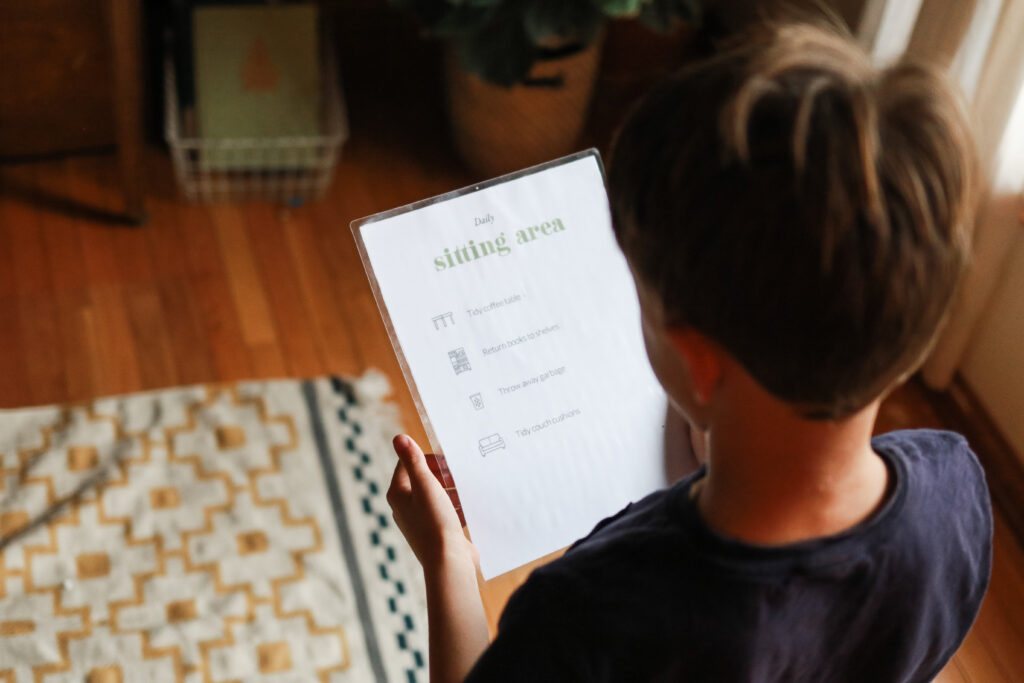
In the morning, after breakfast and Family Gather, I send my kids outside to play while I clear the table and tidy up a bit. After individual learning time and lunchtime, my kids do their “zones” and chores (you get more details in my housecleaning and chores video).
My husband bought a vacuuming and mopping robot from Costco. He said it was a gift so I didn’t have to slave away at keeping the floors clean, but in reality it because he wanted clean floor period. I was skeptical, but now I’m a convert. I highly recommend investing in one of these, especially if you have younger kids that are much more capable of dirtying the floors than cleaning them.
Many, many nights I go to bed with a sink full of dishes and a very messy kitchen. Somedays we do a light day of school (our “floor” goal, I’ll talk about it in a later episode) and we work together to get the house back together. Some days it’s 5:00 and I haven’t started dinner and the fridge is bare. I throw together some pancakes or pick up a pizza from Costco on my way home from the store.
My husband is very supportive of my role as mother and teacher. In our family we believe cleaning and housekeeping is a whole family affair. He has a special talent for seeing what needs to be done and doing it. I recommend having a family meeting and discussing how every member is responsible for keeping the house clean and doing work.
Homeschool Days Are Good, Not Perfect
After homeschooling for years I can tell you that my days are Instagram-worthy, and they are far from perfect. Our homeschool isn’t perfect because we aren’t perfect. My boys fight, I lose my patience, our house perpetually messy. I don’t have chickens or a hobby farm. My boys don’t enjoy watercolor or handicrafts.
Our days are filled with beauty and mess and goodness. We read and experience beautiful stories together. We go on nature walks and find treasures in God’s creations. We learn and live together. Our days are natural and not artificially contrived. They are filled with the full spectrum of human emotions and experiences.
Our homeschool is not perfect, but it is good. And if “good” is enough for Heavenly Father, it’s enough for me.
Homework
- Shadow a homeschool mom this week, or watch one of my daily rhythm videos to get a feel for what a typical homeschool day looks like.
- Prepare yourself (and your family) for taking on more responsibilities around the house. If you haven’t already, teach your children how to do dishes, laundry, and cooking. Assign chores and “zones” of the house to keep clean.