
You have no items in your cart. Want to get some nice things?
Go shopping
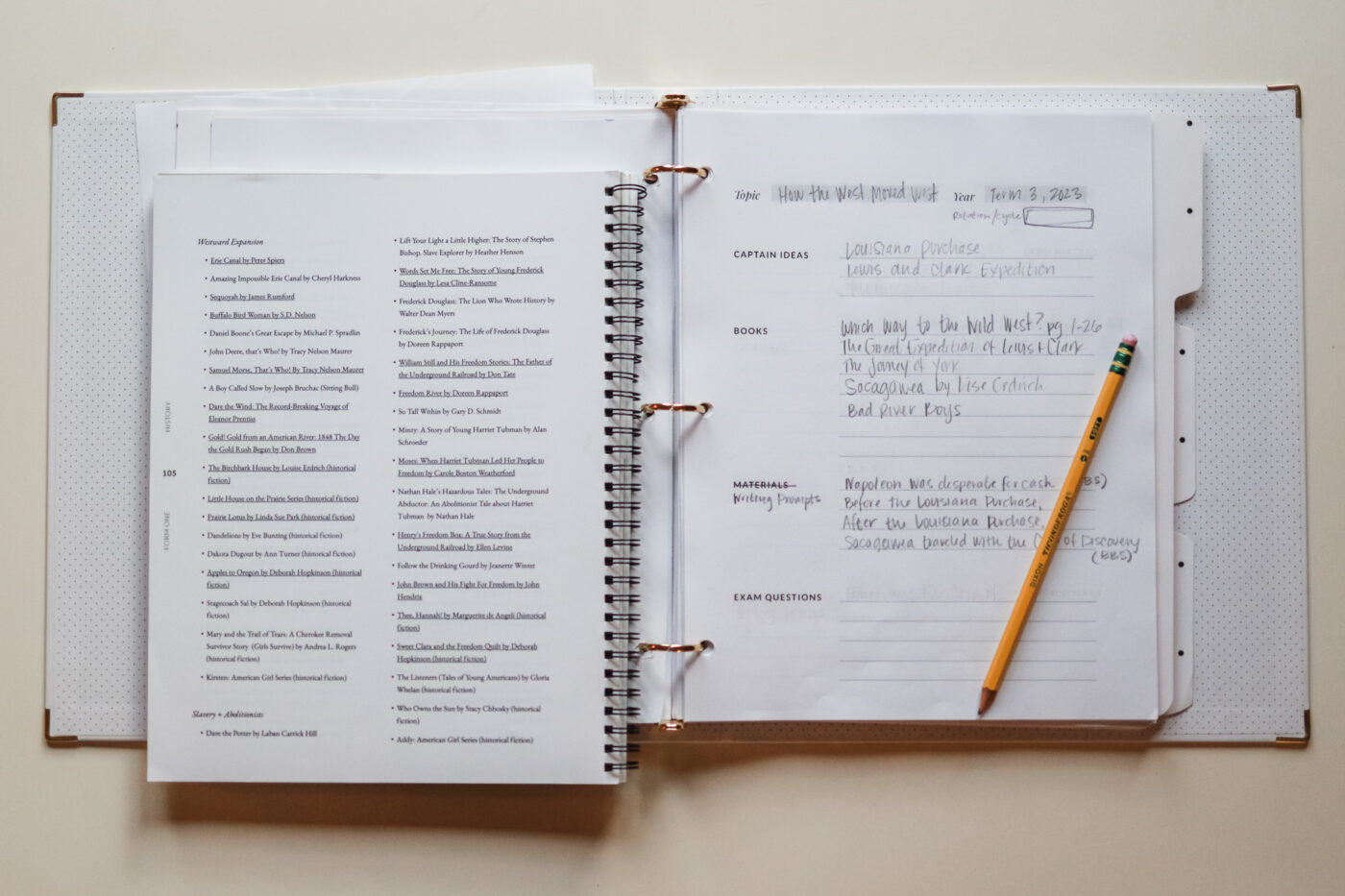
There isn’t one “right” way to create your own custom learning plan, or curriculum, for your family. There are as many methods as there are families! This is just one way to design a learning plan, a method I’ve developed from reading many book on learning and cognitive science, as well as applying it in a real-life setting.
First, forecast what you’ll study (pick broad topics for the year). I use my planning sheets to plan for sub-topics within the broader topics. I used to try to fit these within terms and weeks, but now I just use a sheet for each subtopic and we study it as long as needed before moving on to the next. They usually take about a week, but I don’t force myself to fit inside that time period. For example, here in Ancient History I broke up our study into smaller topics based on our spine: Ancient Egypt, Mesopotamia, Israeal, Ancient China, etc. You can see my history planning sheet below…
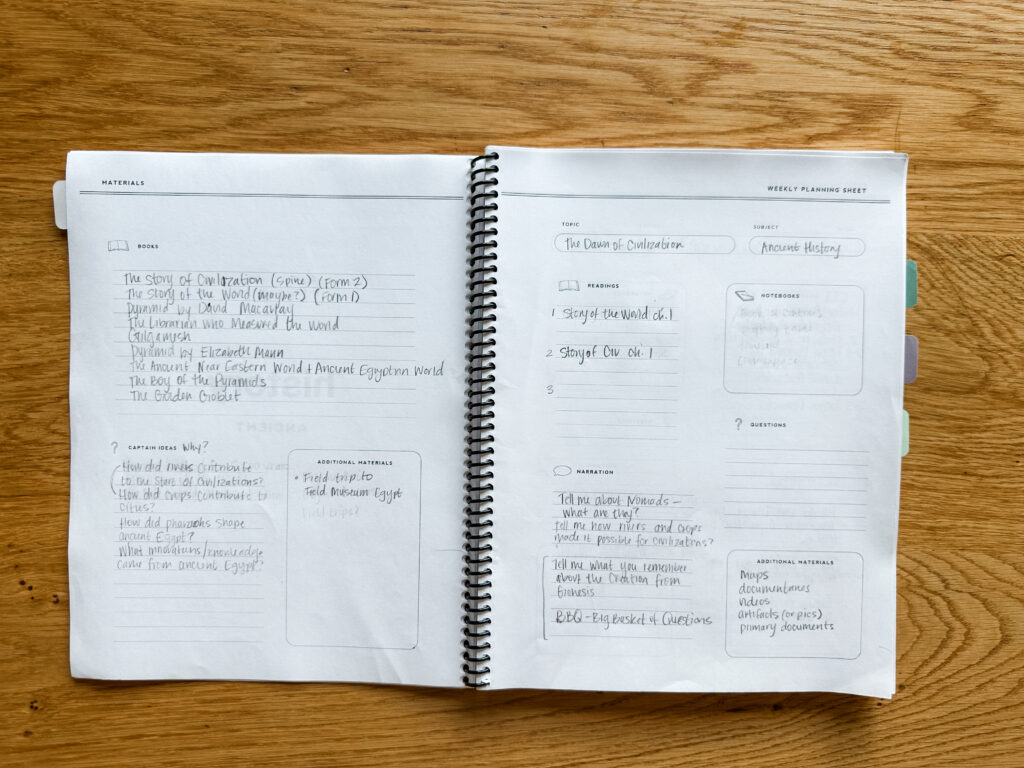
Second, pick your books and materials. I like to reference other curriculum and booklists to see what they choose. I choose a “spine” which is a longer book that gives an overview, or a birds-eye-view of that time period or topic. I then have my kids pick some shorter books on topics within that. For example, we’re using The Story of the World Vol. 1 for the spine for my 1-3 graders, and The Story of Civilization vol. 1 for my 4-6 graders. While we study Ancient Egypt I have books about the Pharaohs of Egypt, Pyramids, and various picture books. They are require to pick one to read on their own. This gives them some choice on what they study. For my younger kids I leave the picture books on a open-facing shelf in their room for them to read in their free-time (or I read to them).
Third, while going through the chapters of the spines I ask myself: “What are the essential questions or ideas from this chapter?” Charlotte Mason called these “Captain Ideas” You can also ask yourself: “Why is this important for my child to know?” Write these down and use as a reference for narration/retrieval questions.
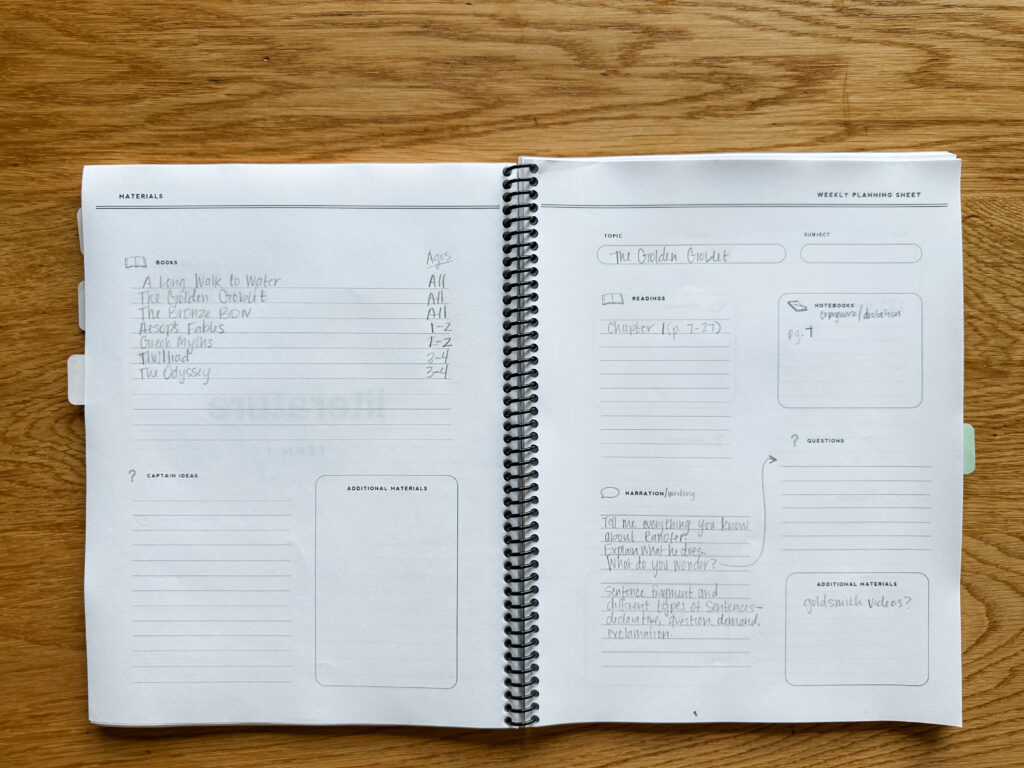
Fourth, ask yourself “what knowledge do my children need to answer the main question(s)?” This question helps me narrow down the narration/retrieval prompts as well as notebooking prompts. Here are some of the ways you can narrate/retrieve:
- Two things (“tell me two things about ______”)
- Two questions (“think of two questions you had while reading”)
- Brain dump (“write down everything you remember about _______”)
- Think, Pair, Share or Think, Write, Share (“Think about ________. Write down what you remember. Turn and share with a sibling/classmate. Discuss similarities and differences”)
- BBQ (Big Basket of Questions. Write down the essential questions from this year and past years. Put them in a basket. Pull one out each lesson and retrieve what you remember. Ask, “how does the current topic relate to this question?”)
Fifth, pick some notebook prompts. These should help your child understand and answer the main questions (captain ideas). I LOVE John Muir Law’s prompts for all notebooks, not just nature journal: What do you wonder? What do you notice? What does this remind you?.
Notebook prompts could include:
- dates and sketching artifacts in their Book of Centuries
- notable quotes in their Commonplace book, as well as sentences or paragraphs for copywork and dictation
- questions and prompts for written narrations and essays
- questions for nature journal and ideas of things to sketch
- ideas of scenes to draw for history/literature
- geographical landmarks to add to their map
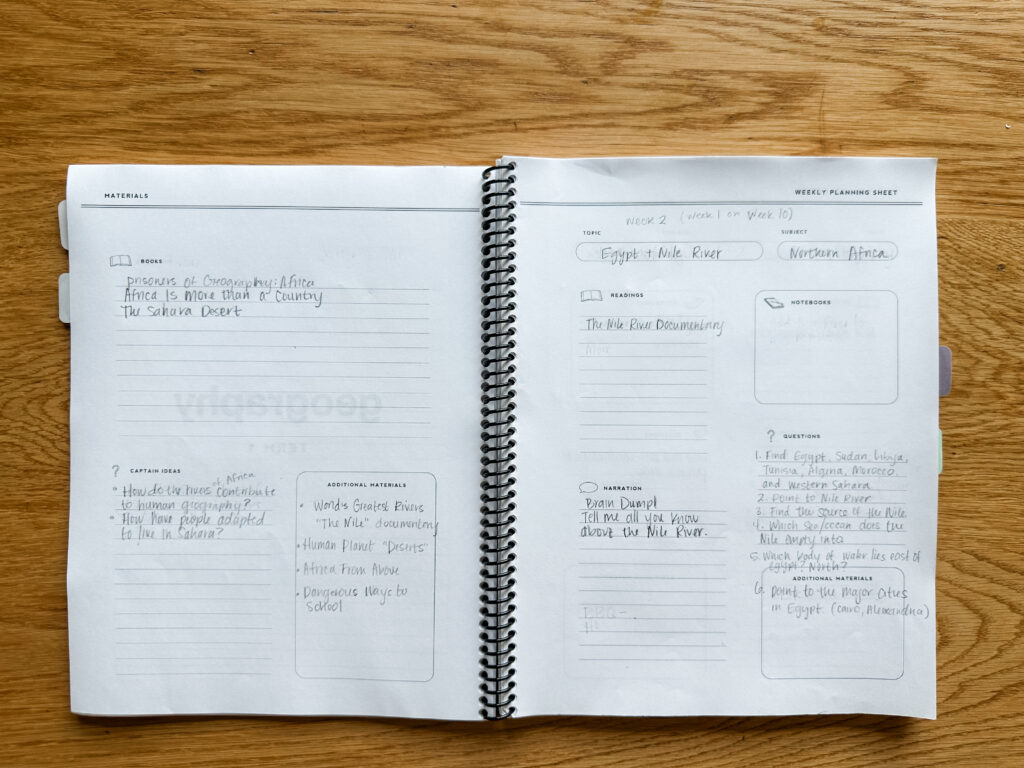
Fourth, add questions (optional). After discussion write down your child’s questions and use that as narration prompts in later lessons. You can also do the Question Formulation Technique for any topic and write down the questions they chose. Refer to these in later lessons. I also use this for map questions in geography. As you can see from my geography plan above, I added map questions to the “Question” section.